Use Case in Software Testing: How to Turn One Into Test Cases
Every path through a use case becomes at least one test case. A worked bank-transfer example shows the test table, and ISTQB's 2023 and 2025 syllabus changes explain…
Vervali tests web applications for SaaS products, portals and ecommerce: functional testing and regression testing, cross-browser and responsive checks on real devices, usability and accessibility testing, API and integration testing, and UAT support, with automation where it pays. Delivered in US hours from an ISO/IEC 17025 accredited lab.


ISO/IEC 17025:2017Accredited testing laboratory

CMMI Maturity Level 3The process is written down and repeats

ISO 9001:2015Quality management

ISO/IEC 27001Information security
The feature works, last month still works, it holds in the browsers people use, and a new user can finish the task. One engagement, not three vendors.
The button does nothing, the form saves the wrong field, the role cannot see what it should. A product owner hears "it does not work." That is functional testing: the feature against the requirement, or against the behaviour we agreed when there was no spec.
Last month's login or checkout broke after this month's release. Support hears it first. The pack has to grow with the product and retire paths that no longer ship, or you pay to retest a museum.
It works on the developer's Chrome and dies on Safari, or on a phone width nobody on the team uses. The customer never files a "cross-browser" ticket. They leave.
A new user cannot complete the task you care about, even though every field validates. Time on task blows out. That is not a bug in Jira until someone watches a session. Usability testing is that watch, with numbers attached.
A keyboard user cannot reach submit. A screen-reader user never hears the error. In US retail and public-sector work that is also legal exposure. The method lives on accessibility testing. On this page it is the add-on on the same flows.
The page is correct and still too slow to finish. Users bounce. Load and response time are a performance testing add-on, quoted against the concurrency you actually get, not a generic spike.
Need a web app that holds up in the browsers your users actually use?
The money paths work this release, and they still work after the next one. The pack grows and retires with the product, not as a museum you keep paying for.
The journeys that make money or create risk: sign-up, login, the core task, payments if you take them, admin roles, and the failure cases. If there is no written requirement, we reconstruct intended behaviour from the product owner, last release notes and the current build, then test against that. You sign the expected result before execution, so a fail is a product decision.
The pack is the set of paths users still take, not every closed ticket. It grows when a new journey ships. It retires when a path is removed or no longer used. The product owner signs that list. A tester does not keep a favourite case alive on their own. That sign-off is what stops the suite becoming a museum you still pay to run.
A path moves to automation when it is stable, runs often, and is cheaper to keep alive than to re-execute by hand. Login, checkout and the journeys that still make money after last month's release are the usual candidates. A checkout experiment whose fields change every sprint stays manual. The split arrives before the quote. Tooling and payback sit on automation testing services, not here.
Chrome, Edge, Firefox and Safari on the widths that already convert. Safari and the phones that make money run on real hardware, not a resized desktop.
Chrome, Microsoft Edge, Firefox and Safari. Versions: current and the previous major release, unless your analytics say a third version still produces sessions. Viewport widths start from the widths that already generate traffic for you. A typical cut is a phone width, a tablet width and a desktop width. Extra widths are added only when the data justifies them.
Chrome · Edge · Firefox · Safari Current and previous major Phone, tablet, desktop widthsSafari on macOS, and the phones that appear in your top sessions, run on real hardware. That is where rendering, input and viewport behaviour actually differ. Chromium and Firefox also run in a controlled desktop environment. Emulation widens the viewport set. It does not replace the hardware pass on the browsers that make money. If a device is not in the lab, we say so in the design before we quote, rather than promising a matrix we cannot run.
A new user can finish the task you care about. You get success rates and a ranked list of where they stall, not a slide of quotes.
More participants, less depth, faster. Real people complete your tasks on a panel you approve. There is no facilitator in the room. You get volume and a ranked list of where people stall. This is the default on a web testing engagement when you need evidence this month, not a research programme.
A facilitator, typically five to eight participants, set tasks, and a recording. Deeper, slower, and priced as its own scope. We do not bury recruitment inside a web-test quote. You supply the users, or recruitment is a line item. If you do not want that cost, stay on unmoderated.
Task success rates, time on task, a System Usability Scale score, session recordings, and a ranked list of what to fix. Not a slide of quotes. The numbers are what a product owner can take into a sprint. Recruitment stays visible: you supply participants, or we run unmoderated work on a panel you approve.
WCAG on the same journeys, and load against the concurrency you actually see. Quoted after the web scope is fixed, not folded into it.
A WCAG pass on the same journeys, with keyboard and a screen reader, not a full-site audit. That audit, VPAT support and the legal deadlines sit on accessibility testing. On this page it is an add-on quote once we know how many templates those flows use.
A load profile on the same journeys, against the concurrency you actually see. The method sits on performance testing. On this page it is an add-on quote from that profile, not a generic spike tacked onto functional work.
You sign the coverage, defects land in your tracker, and a named tester is on the go-live call. First report inside two weeks.
What We Read
Tickets, Figma, old cases, analytics. When there is no specification, we walk the paths that make money or create risk, write them down, and send them back for a yes.

What We Design
A coverage model, the browser matrix, and the manual against automated split. Nobody runs anything until that design is signed off.

How We Execute
Cadence follows your release train. Defects land in your Jira with reproduction, environment and evidence. A blocker escalates the same day, in US hours.

What You Receive, and When
A short status: what ran, what failed, what is blocking release. Daily in a live cycle, otherwise at an agreed cadence. Leadership gets a release-risk view, not a 40-page PDF.

Who Is on the Call at Release
A named tester on the go-live call in US hours. Smoke on the production-like build, then a watch on the first hours after release.
A named tester is usually assigned within a week of NDA and staging access. First execution and the first written report typically land inside two weeks. The free one-flow test on staging is the fastest first look.
Airline, finance and government work where coverage went up and customer issues, testing time or regression time went down.
India · major airline · booking and check-in
Before: coverage on the booking and check-in platform was too thin for the release pace, so customers were reporting issues testing had not seen. Vervali built a functional and regression suite around the paths that sell seats and get passengers to the gate. After two release cycles: 85% test coverage, and 70% fewer customer-reported issues.
85% test coverage 70% fewer customer-reported issues Two release cyclesUAE · SME finance platform · web and mobile
Before: testing time was eating the sprint, and users were paying for it in a clumsy web and mobile experience. Vervali put automation on the repeatable finance journeys and kept exploratory and UAT support in human hands. After: 98% user satisfaction, and 40% less testing time.
98% user satisfaction 40% less testing time Web and mobileUAE · Dubai government · border-security and immigration
Before: regression took days and still missed coverage. Vervali expanded automated regression across the products in scope and cut the manual remainder to what still needed a person. After: coverage from 70% to 80%, regression from days to hours, and manual regression effort more than halved.
Coverage 70% to 80% Regression in hours Manual effort more than halved
OUR BLOGS

Every path through a use case becomes at least one test case. A worked bank-transfer example shows the test table, and ISTQB's 2023 and 2025 syllabus changes explain…
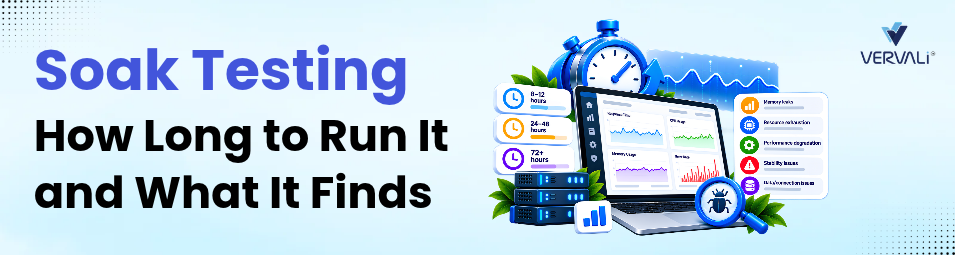
What a soak test is, how it differs from load, stress and spike tests, how long to run it, the metrics that decide a pass, and how JMeter, k6 and Gatling hold a load…
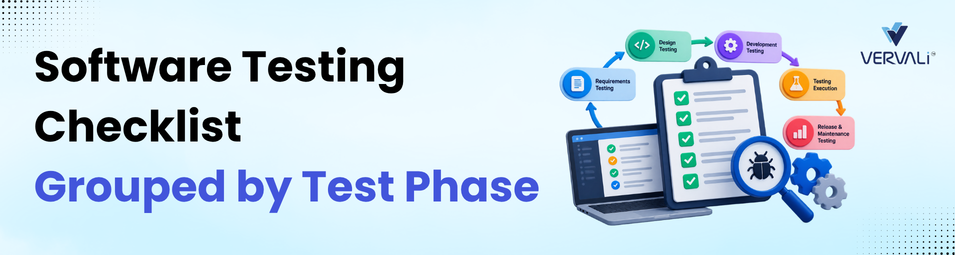
This software testing checklist groups every item by the phase of the test process it belongs to, marks the items teams routinely skip, and shows how to wire the lis…
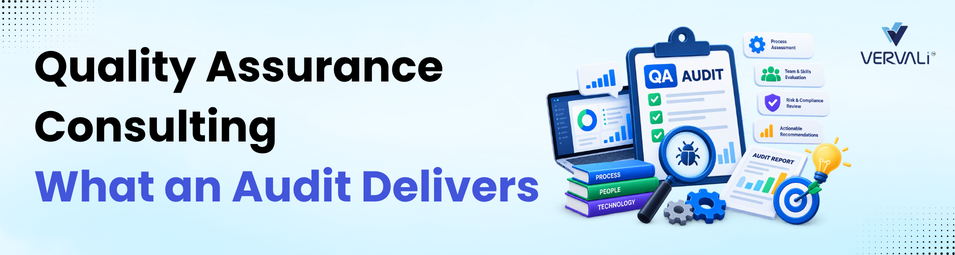
This guide explains what a QA maturity assessment scores you against, what the deliverable looks like on the last day, and when advisory work is the wrong purchase.
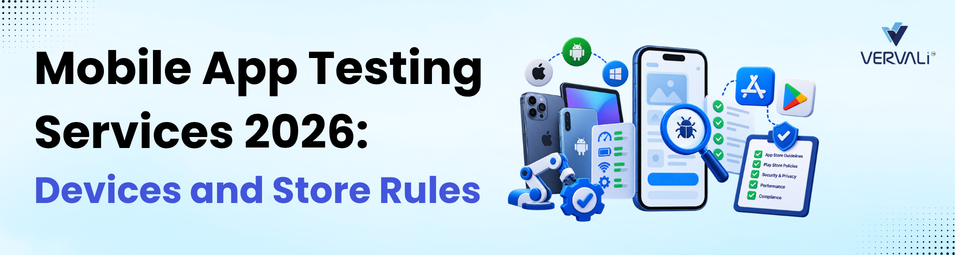
This guide explains what mobile app testing services cover, how to size a device matrix from United States traffic data, and what Apple and Google check before a rel…

This guide prices the five QA outsourcing engagement models against the cost of an in-house hire, and names the situations where outsourcing is the wrong call.

This article ranks nine software testing companies on their verified review evidence and engagement floors, and sets out the criteria before the ranking.

A ranked comparison of ten IT staff augmentation vendors on verified Clutch data, with the ranking criteria stated before the list. Covers why the highest-rated firm…

Our Expertise


Trusted by 150+ Leading Brands

A Strong Team of 275+ QA and Dev Professionals

Worked across 450+ Successful Projects
 Email Us
 Call Us
From flawless code to flawless quality - we design, develop, and test digital solutions that deliver real results.